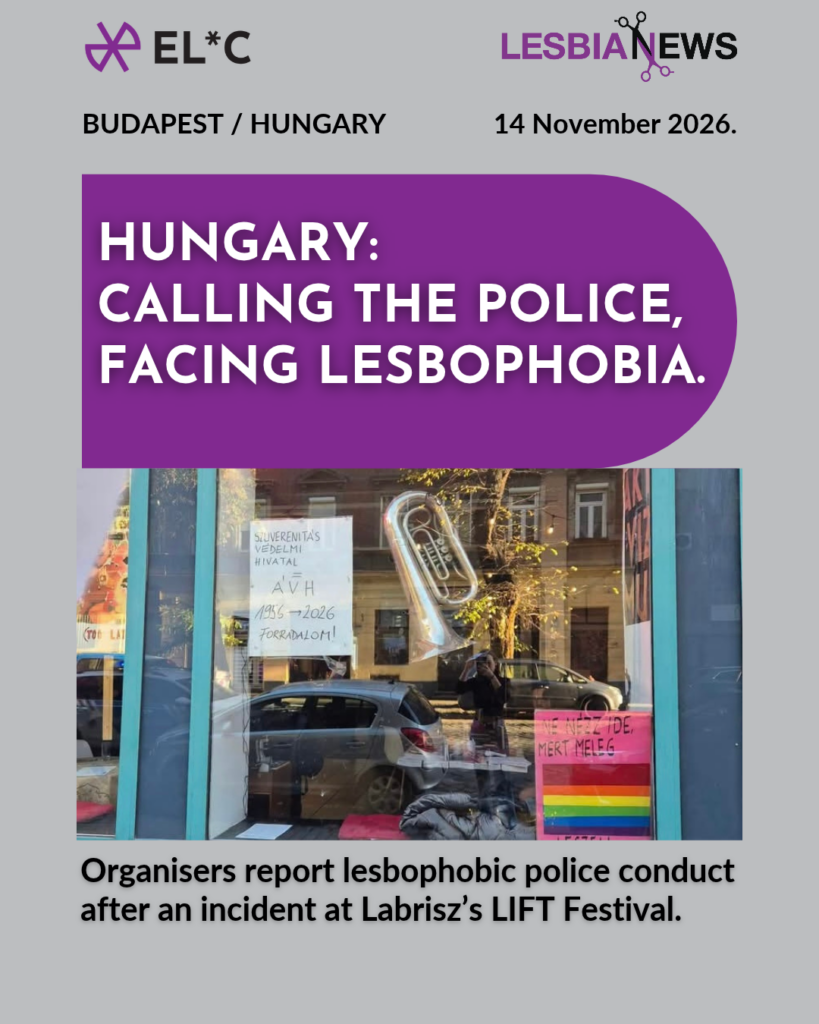

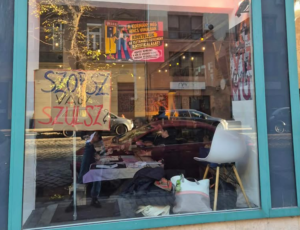
After an incident at Budapest’s LIFT Festival (the Festival of Lesbian Identities, organised by our sisters at Labrisz Lesbian Association), organisers report homophobic jokes, sexualised behavior and intimidation by responding police officers. Hungary’s political change must also reach the institutions responsible for protecting lesbians.
On Saturday 14 November, people inside FREEDOM, the independent cultural and educational centre run by the Freeszfe Association in Budapest, heard a loud bang. The venue was hosting the 16th LIFT Lesbian Identities Festival. Human rights banners from Labrisz’s activism exhibition hung in the street-facing windows.
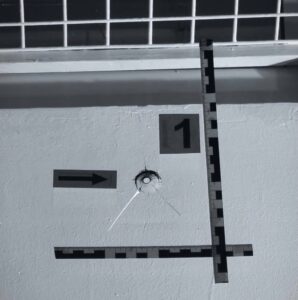 According to the organisers, they then discovered damage to one of those windows. The outer pane of double safety glass had shattered; the inner pane remained intact. People were sitting inside. Whether a shot was fired has not been established in their account.
They called the police because they feared for their safety.
Police protection turned into humiliation
Four police units attended, but the organisers say they offered conflicting explanations: a stone, a possible air-rifle shot, or an undetermined cause. They also report that residents across the street were not asked whether they had witnessed anything.
When a Labrisz colleague asked, whether they could expect a follow-up, an officer allegedly looked her up and down, winked and replied: “I’ll definitely call you back”. Other officers reportedly made lesbophobic jokes. Another unexpectedly showed a Labrisz representative a video on his phone of a hawk drowning a pigeon. This video, shown to a lesbian activist hours after her space may have been shot at, hardly needs accountability.
It’s also worth noting that the following day, an insulting message appeared on the storefront: “Disgusting! What a standard!”. The organisers aren’t sure whether the two incidents are connected.
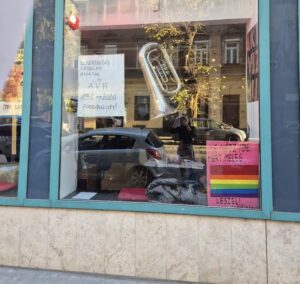 We are talking about a lesbian festival where people feared someone might have attacked them with a weapon. In such a context, the police behavior compounded fear and humiliation. Sexualising a lesbian’s request for information dismisses her right to protection. Lesbophobic mockery clearly tells our lesbian sisters that officers do not take their lives seriously. Showing an activist a violent video in those circumstances is experienced as intimidating.
For EL*C, the conduct described is institutional lesbophobia: misogyny and hostility towards lesbians expressed by people exercising state authority. Obviously, the uncertainty about what damaged the window has nothing to do with the seriousness of these allegations. So both the incident and the reported police misconduct require a thorough investigation.
Orbán lost. Institutional lesbophobia must go too.
Hungary has changed politically. April’s election ended Viktor Orbán’s sixteen consecutive years in government, and Péter Magyar took office on 9 May. That defeat opened a real opportunity to reverse years of discrimination.
There have also been legislative advances. For example, on 13 October, Parliament voted by 139 to 51 to remove anti-LGBTQ provisions from the 2021 law restricting access to content about sexual and gender diversity. These changes do not, however, dismantle every discriminatory provision or guarantee that public institutions will treat lesbians equally.
In light of what happened, it is clear that elections can remove a government without removing the institutional habits that took root during its rule. Years of official hostility towards LGBTI people cannot be undone by assuming that police culture will change automatically alongside legislation.
Lesbians in Budapest need to experience political change when they report a threat, ask an officer for information or seek protection for a community event. If those encounters still bring ridicule, reform has not reached the people it is supposed to protect.
All of us lesbian activists know very well that when asking the police for help means risking humiliation, we will hesitate before reporting the next threat. That leaves lesbian communities more exposed and weakens trust in public institutions.
Accountability beyond the ballot box
Hungary is not the only European country where police conduct raises serious concerns. In France, Amnesty International demanded a permanent ban on stun grenades in protest policing on 7 October 2026, following a serious injury to a 15-year-old in Lens that authorities and media attributed to such a device. In Germany, Amnesty’s 2025 report documented police violence against Palestinian solidarity protesters and at Berlin’s Internationalist Queer Pride in July.
Even if the circumstances differ, they nevertheless raise a shared question: who holds the police accountable when their conduct undermines the safety and rights they are supposed to protect?
EL*C stands with Labrisz, Freeszfe and the communities who keep FREEDOM open. We support the organisers’ demands for witness interviews, expert examination of the window damage and an investigation into whether the subsequent abusive message was connected. The reported behaviour of responding officers must also face independent scrutiny and effective accountability.
We call on Hungary’s government to make institutional reform part of its commitment to equality: accessible and independent complaints procedures, clear consequences for discriminatory conduct, and training on anti-LGBTI hate crime that specifically addresses lesbophobia.
As Labrisz and Freeszfe say: “We will not be afraid”. Their refusal to retreat deserves our solidarity and demands a response from public authorities that makes lesbian spaces safer.
No lesbian should have to choose between facing a threat alone and risking humiliation from law enforcement in any situation, and especially when we call them for help because we are at risk.