
For too long, the health of lesbian, bisexual and pansexual women has been ignored — both by research and by the healthcare system. L-Health set out to change that. Here’s what they found, and why it matters.
What is L-Health?
 L-Health is a European research project focused on the health of LesBian communities in primary care — lesbians, bisexual and pansexual women, non-binary people, and heterosexual women who have relationships with women. The project is co-funded by the European Union through the CERV-2023-EQUAL programme. EL*C is a partner of the project, responsible for communication and community outreach.
The project’s core goal is straightforward: to promote clinical practice excellence for LesBians in primary care. That means identifying the health inequalities we face, understanding what healthcare professionals know (and don’t know) about our needs, and developing concrete training tools to improve clinical practice. The research is grounded in feminist and intersectional principles. Age, migration background, racialisation, gender identity, functional diversity, place of residence: all of these shape who we are and how the healthcare system responds to us.
What the research found
Over 850 LesBians participated in the study’s online chain-referral survey, and 56 took part in in-depth group interviews. The picture that emerges is one of a healthcare system that was simply not designed with us in mind.
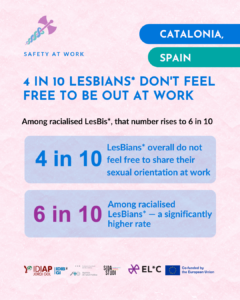
1 in 3 LesBian has felt discrimination based on their sexual orientation at their GP. Among lesbians, that figure rises to 36%. Among LesBians with non-cisgender identities, it reaches 43%.
Almost half of bisexual and pansexual women have never disclosed their sexual orientation to any healthcare professional at their primary care centre. The reason is a system that assumes every patient is heterosexual, that asks about boyfriends and husbands as a matter of course, that repeats the same heteronormative questions at every appointment – that system teaches us, over time, that it is safer to stay silent.
The study also documents what participants called the double myth: lesbians are told they have no sexual health risk (because they don’t have penetrative sex with a cisgender penis), while bisexual women are labelled “high risk” by default. Both stereotypes cause real harm. Both lead to inadequate, unequal care.
And yet, when LesBians did feel safe enough to be open with their healthcare professionals, their satisfaction with the care they received went up significantly.
What L-Health built – Research alone is not enough.
L-Health has produced three concrete outputs designed to translate findings into change:
- A Good Practice Guide for primary care professionals, grounded in both evidence and the lived experiences of LesBi* communities.
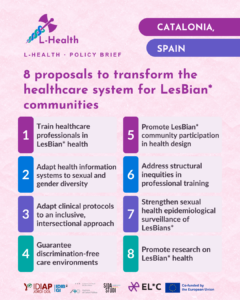
- A Policy Brief — From invisibility to equity — containing eight specific proposals for policymakers and health planners.
- A Pilot Professional Training Programme, developed with Sida Studi, which has already been tested with 21 healthcare professionals and 37 researchers and students, with measurably improved knowledge and self-efficacy across all groups.
These are tools that can be picked up and used by health systems, by training institutions, and by the advocates who push for change from the outside.
What EL*C’s role has been
As the communication partner of L-Health, EL*C has been responsible for making the research visible, not just within academic circles, but to our communities directly. Throughout the campaign, we have published content across our social media platforms and website, reaching audiences across more than ten countries. The response has been that this research resonates: LesBians* recognise their own experiences in the data. That recognition is, in itself, a form of validation that the health system has too rarely offered.
Why this project matters beyond Catalonia
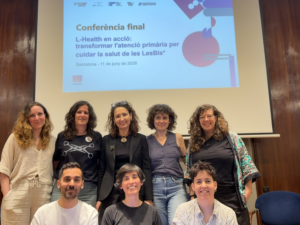
L-Health was conducted in Catalonia, with the Catalan primary care system as its frame of reference. But the dynamics it documents (invisibility in clinical settings, heteronormative assumptions, stereotypes about lesbian and bisexual women’s sexual health, the absence of our data from health records) are not unique to one region or one country.
From EL*C, we know from our NGO members that LesBians* in many of our countries face these same barriers, often without any research to name them. L-Health gives us an evidence base to make the case – to health systems, to policymakers, and to the international community – that this is a structural problem that requires structural solutions.
Read more and download the project materials
Below you will find two documents available for download: the L-Health Explanatory Document, which provides a full overview of the project’s objectives, methodology and approach; and the L-Health Key Findings Report, which presents the main research results in accessible format.