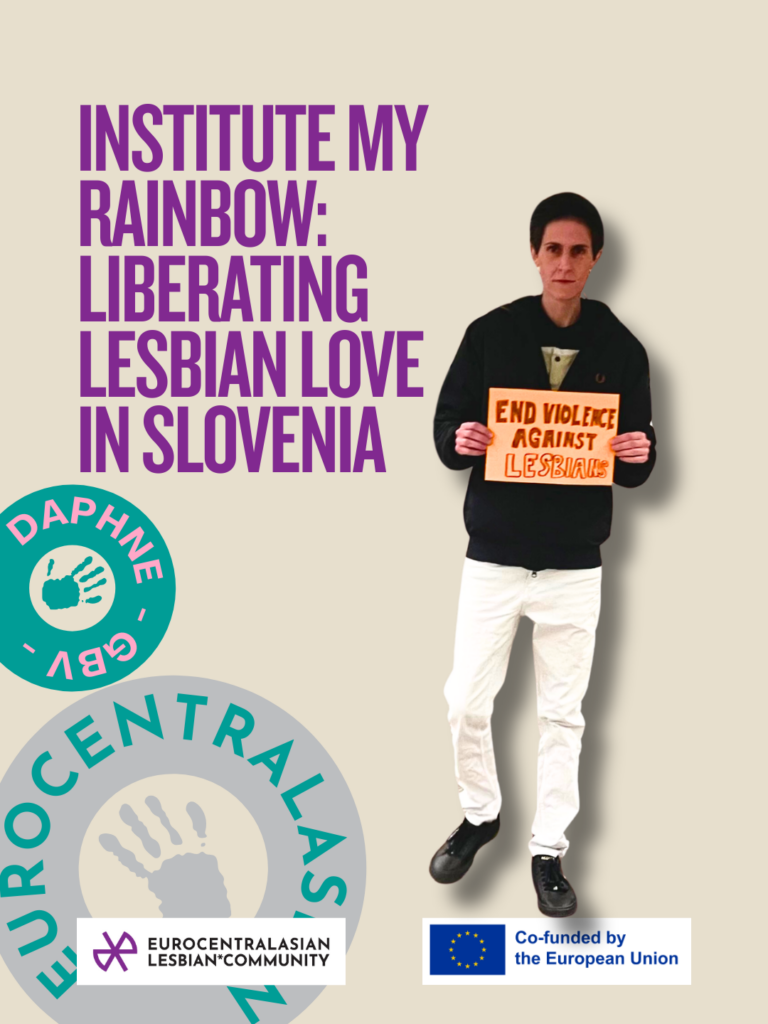

Imagine a Europe where lesbians and non-binary people do not have to negotiate their safety every time they step into the street, a clinic, a classroom or their own home. That is the horizon behind the EL*C Grant-Making Programme , and it is within this framework that one Slovenian organisation has been quietly reshaping what protection can look like.
 Institute My Rainbow (Zavod Moja Mavrica) did not begin with grand slogans. It began with a recognition: violence, housing precarity, burnout and street harassment are not isolated incidents in Slovenia – they are daily realities for many LBTIQ women and non-binary people. Survival, they decided, was not enough.
With financial support from EL*C’s Grant-Making Programme Against Gender-Based Violence, they launched “Liberating Love: Standing Together Against Gender-Based Violence”, a project grounded in harm reduction. Not the illusion that violence disappears within a funding cycle, but the conviction that it can be confronted, interrupted and collectively resisted.
Harm reduction as political practice
My Rainbow approached gender-based violence as it actually unfolds – across homes, streets, institutions and inner lives. They delivered 86 hours of psychosocial counselling, reinforced by supervision and intensive collaboration to ensure trauma-informed, sustainable support. For survivors whose lives intersect with migration, sex work, neurodiversity or mental health crises, this meant services built around reality rather than respectability.
Street outreach became a lifeline. Through 22 targeted actions in queer-coded public spaces, counsellors engaged young LBTIQ people in conversations about safety, suicidality, housing insecurity and everyday violence. Using informal, presence-based methods, they listened before they intervened.
Meanwhile, Theatre of the Oppressed moved beyond rehearsal rooms and into Ljubljana’s streets. Scenes of harassment and lesbophobic aggression were staged in public, inviting passers-by to step in, interrupt and rehearse alternative outcomes. In a culture that often defaults to silence, this was an invitation to practice solidarity.
Inside the community, 64 peer-support meetings and 67 public events – from language exchanges to workshops on anxiety, people-pleasing and relationship violence – strengthened collective resilience. And to influence future systems, five social work students were mentored for extended placements, while workshops at the Faculty of Social Work centred lesbian experiences in professional training.
From visibility to systemic change
The impact was tangible. Survivors accessed long-term support tailored to their lives. Public conversations about lesbophobic healthcare, hate speech and street safety reached thousands online and hundreds in person. Gender-based violence against lesbians was no longer a private burden but a public issue.
The project culminated in a comprehensive report on GBV affecting LBTIQ women and non-binary lesbians in Slovenia, weaving together data, lived experience and recommendations for professionals. Crucially, the alliances built – with youth centres, universities, queer collectives and international partners – extend beyond the lifespan of the grant.
My Rainbow’s work demonstrates what a systemic response looks like when lesbians* lead it: tailored counselling instead of one-size-fits-all models; street-level harm reduction for homeless lesbians and sex workers; creative interventions that transform bystanders into participants; and professional training that challenges institutional blindness.
“Liberating Love” was never framed as a finished chapter. It is a foundation – a reminder that protection is not delivered from above but constructed collectively, persistently, and often against resistance.
If Europe is serious about combating gender-based violence, it would do well to look not only at its directives, but at the communities already building the future on the ground.
NOTE: You can learn more about the results of the first cycle of the EL*C’s Grant-Making Programme by reading this article.