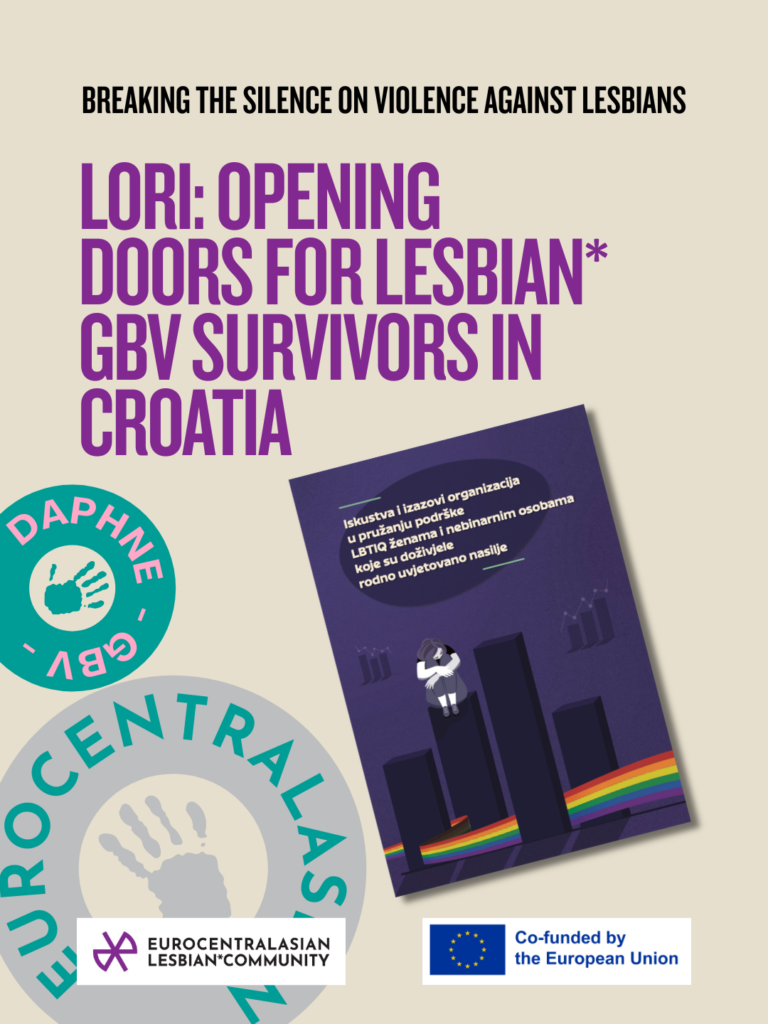

 Across Europe, many gender-based violence (GBV) services say they are open to everyone. Yet for lesbian and non-binary survivors, that promise often falters in practice. In Croatia, LORI – Lesbian Organisation Rijeka – set out to close that gap through REACH OUT: Developing Adequate Support for LBTIQ Women and Non-Binary Gender-Based Violence Survivors, a project financially supported by the EL*C’s Grant-Making Programme Against Gender-Based Violence.
Working alongside the women’s support organisation SOS Rijeka, LORI focused on a simple but urgent question: what happens when a lesbian survivor calls a hotline or seeks refuge in a shelter that lacks the tools to understand her experience?
Turning openness into real inclusion
The project began by mapping the realities faced by Croatian GBV services. Nationwide research and in-depth interviews revealed a recurring contradiction. Many organisations considered themselves inclusive, yet more than half did not clearly name lesbian or non-binary survivors among those they support, while most professionals reported lacking confidence or knowledge when addressing LBTIQ-specific experiences of violence.
To bridge that gap, LORI translated research into practical action. The team produced a detailed report on challenges faced by service providers and distributed it, together with an English summary, to more than 300 counselling centres, shelters, activists and mental-health professionals across the country.
They then developed comprehensive Guidelines for supporting lesbian* survivors in cooperation with established feminist organisations, offering concrete advice on issues ranging from recognising patterns of control in same-sex relationships to addressing minority stress, internalised stigma and trans-inclusive counselling practices. A training session in Rijeka brought together professionals from ten organisations, while an online networking event connected shelters, counsellors and activists across three Croatian counties to exchange experience and strengthen referral networks.
The impact extended beyond individual participants. Professionals reported becoming more aware of their own assumptions and better equipped to ask rather than presume, a shift seen as essential for building trust with survivors. By distributing the Guidelines widely, the project ensured that even services unable to attend training now have practical tools when lesbian survivors seek help.
Rather than creating parallel support systems, REACH OUT aims to transform mainstream women’s services themselves, reducing reliance on a handful of queer organisations and strengthening prevention and protection across the wider GBV sector.
Encouraged by the results, LORI has secured further funding in the programme’s second cycle to deepen collaboration with counselling centres, expand inclusive practices nationwide and provide free psychological and legal support, an effort designed to ensure that lesbian survivors in Croatia can finally access informed, affirming help when they need it most.
NOTE: You can learn more about the results of the first cycle of the EL*C’s Grant-Making Programme by reading this article.