
MARCH 8th 2026. By Carla M. Reale
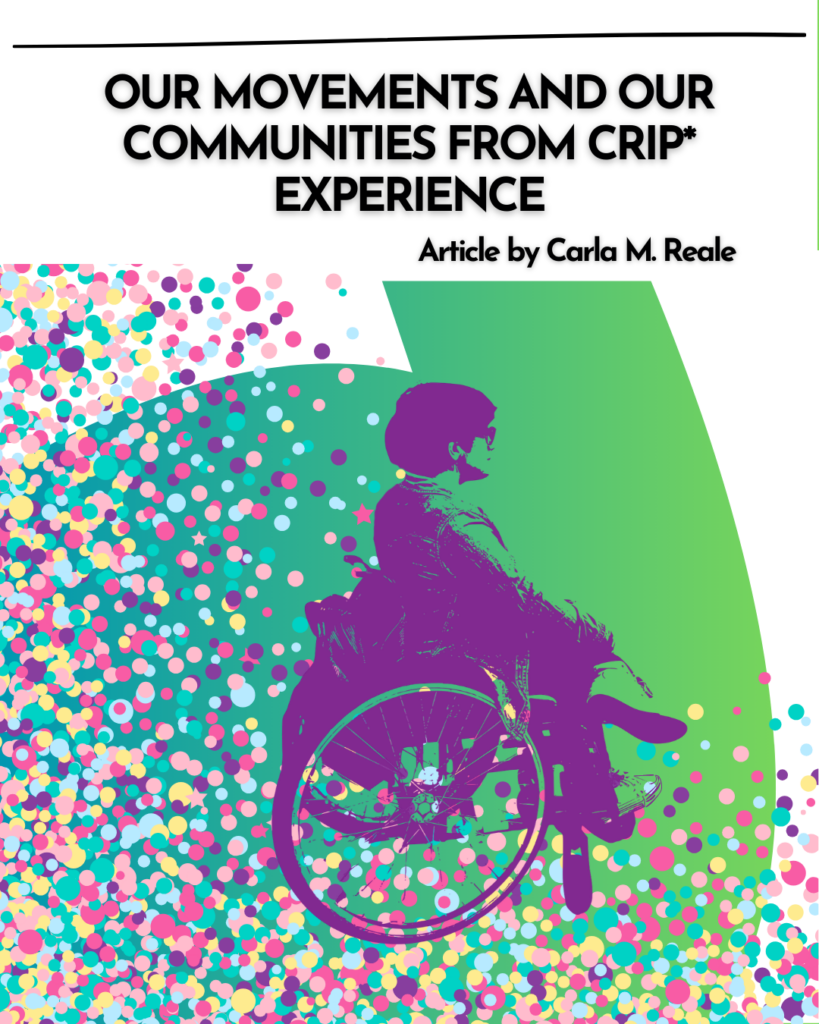
Last spring, during the first Italian Dyke March in Rome, between chants and the collective joy of our slogans, we soon understood that the after-march party would not be accessible to wheelchair users. I spent most of the march moving back and forth through the crowd, explaining, asking, trying to gather allies for mobilising. During the party, a small group stayed outside the entrance as a form of protest. Most people went in. There was no hostility, no dramatic confrontation, just an unthinking oversight, a certain superficiality in declaring a space accessible without checking what this actually meant. Standing there, outside a place I had imagined as ours, I felt anger, but even more than that a subtle, sharp sense of loneliness. Not simply the frustration of inaccessibility for some of us, but the realisation that some bodies, some lives, are never really foreseen or anticipated, and their exclusion is seen as acceptable, even in spaces we call home. The absence of these bodies is taken for granted, just as abled-bodiedness is assumed.
As lesbians and queer people, we learn soon enough what it means to exist at the margins of normativity: to negotiate visibility and invisibility, to carve out existence within spaces not made for us. My own diagnosis was entangled with these same forces. A few years ago, I discovered that I had been severely deaf since childhood. I guess the delay was not accidental. It reflected the same ableist assumptions that shape our environments: the quiet belief that certain bodies are standard, neutral, unproblematic. For years, I adapted. I coped. I normalised.
But adaptation came at a cost I am still learning to name, not only in terms of effort, but in terms of identity. In terms of that persistent feeling of failing to find spaces where I could fully belong. That is why the staircase at the party did not feel like a minor organisational mistake. It felt familiar. It felt like the same subtle push toward normalisation and self-erasure that many of us already know too well, in a space that promised community and belonging.
But wasn’t feminism, as Marcia Tiburi once suggested, supposed to be the opposite of loneliness? An inaccessible event signals who belongs and who does not. When participation depends on individual negotiation, autonomy becomes a private burden rather than a collective commitment.
That episode is not an exception; ableism is embedded in the societies we inhabit, it inevitably enters our movements. The question, then, is not whether we are involved (because yes, we are), but whether we are willing to rethink ourselves. Accessibility is not a mere request for inclusion into existing structures, but an invitation to question who designed them, and for whom. Two concepts have long been central to lesbian feminist politics: care and self-determination. What if a disability perspective could help in further elaborate these notions?
A crip* perspective insists that autonomy is inseparable from care, because none of us is self-determined alone, and that care is inseparable from justice. Rethinking care means rethinking community: it is the deliberate work of organising new forms of collective life so that no one remains outside the door. Lesbian feminism has long challenged compulsory heterosexuality and the naturalization of gender roles, but we still stick to a narrow stance when it comes to defining what is desirable, lovely, erotic and this very belief shapes our relationship, our spaces, our community, our political agendas.
All these issues kept coming back in my mind while working on my legal analysis on how international disability law could provide protection for lesbian, bisexual, and queer women and non-binary persons with disabilities in Europe. The document I was analysing, the UN Convention on the Rights of Persons with Disabilities (CRPD) was shaped by grassroots disability organisations across the globe. Disabled activists forced international legal mechanisms to recognize equality, participation, and self-determination as enforceable rights. They insisted on transparency and accountability. They centered lived experience under the motto “Nothing about us without us”, shifting the paradigm from protection to agency. The disability movement has already done something extraordinary: it transformed international law from below. What could lesbian/queer politics learn from that collective power?
What we can possibly do is build from that margin, counting on the radical promise of the CRPD, arguing for an explicitly intersectional point of view that centers on LBQ women and non-binary persons with disabilities. Yet beyond legal analysis lies a simpler, more unsettling question: Who do we imagine when we say “we”? If the CRPD teaches us anything, it is that legal language can be reshaped from below, through insistence, through collective voice, through refusal to remain invisible.
Crip and lesbian perspective on disability rights is a tool for advocacy, certainly: a resource to demand accountability, to expose structural gaps, to insist on rights that already exist on paper. But it is also something more intimate and more ambitious. A starting point for conversations within our own movements. A mirror held up to our own spaces. An invitation to rethink how we organize care, how we imagine autonomy, how we define community.
As Alison Kafer reminds us, crip futurity is about imagining realities where disability is not treated as deviation or delay or a burden, but as a generative political force. Producing knowledge from this standpoint is not only meant to provide tools for advocacy, but also to open up a shared space of imagination of a crip, queer, dyke feminist futurity in which none of us is left outside the door.
NOTE: *Crip, a reclaimed form of cripple, is an academic and political term that, like queer/dyke, reclaims a once offensive label to turn it into a tool for critique, knowledge production, community and resistance. Emerging alongside and through queer theory, crip theory reveals able-bodiedness as a dominant social norm and exposes the structures that marginalize disabled bodies and minds. In alliance with queer and feminist activism, crip names both a disabled identity and a radical method for challenging norms around bodies, desires, and futures.