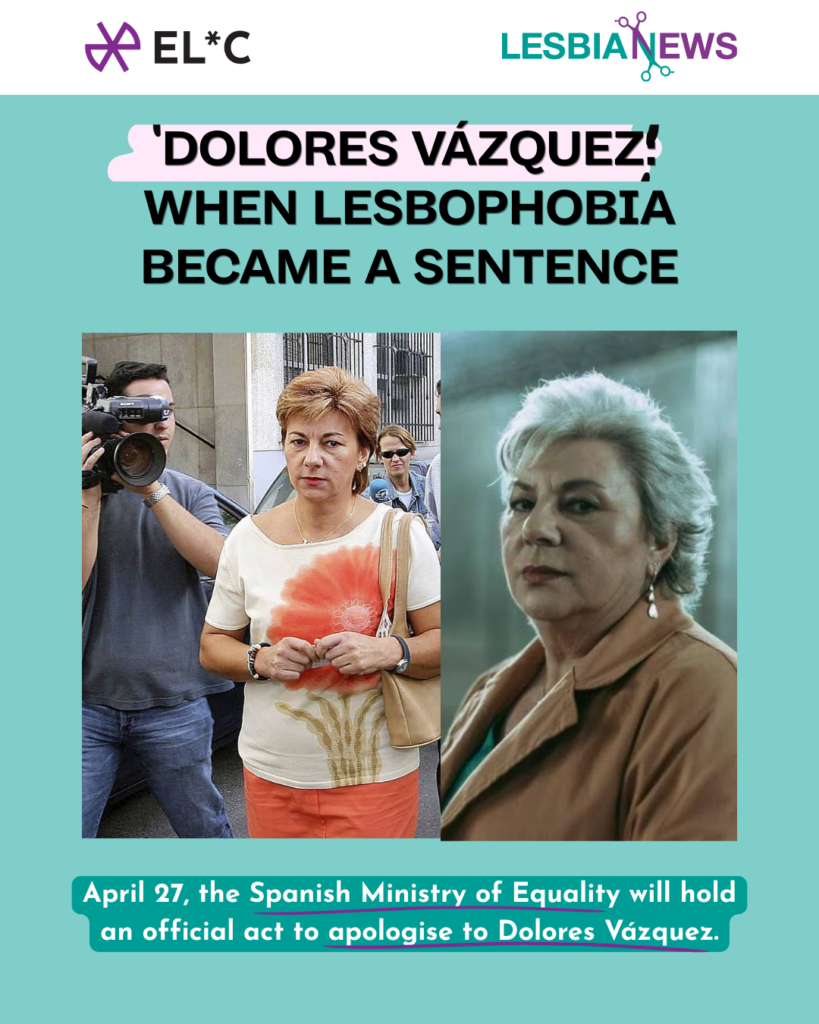

She was convicted before the trial began.
She was convicted for being a lesbian.
The case of Dolores Vázquez: how Spain imprisoned an innocent lesbian using prejudice as evidence – and what 26 years of silence has cost her. This is one of the biggest miscarriages of justice in Spain’s recent history.
Madrid (Spain) – April 27, 2026
EL*C is present at today’s reparation act in Madrid (Spain). This piece is our testimony.
Today, in Madrid, something is happening that should have happened twenty-six years ago. Or even never happened. Dolores Vázquez –known to those who love her as Loli– is receiving an institutional act of recognition for the harm done to her. She has been asking for an apology, a real apology, from the Spanish government for years. She said as much in the documentary in which she finally agreed to speak: Dolores. La verdad sobre el caso Wanninkhof (HBO, 2021). Today is a step. It is not enough, it’s true, but it matters. And if you don’t know her name yet, you need to.
What happened
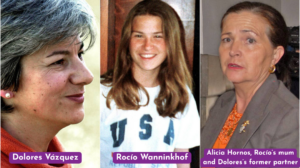 In October 1999, a 19-year-old woman named Rocío Wanninkhof disappeared near Fuengirola, on Spain’s southern coast. Her body was found 25 days later. She had been stabbed. Spain was in shock, and the pressure to find a culprit was immense.
The investigation focused almost immediately on Dolores Vázquez, 48, a hotel manager from Galicia who had been in a long-term relationship with Rocío’s mother, Alicia Hornos. They had lived together for years. Dolores had helped raise Rocío and her siblings. She was, in every meaningful sense, part of the family.
She was also a lesbian. And in the eyes of the media, the police, and eventually a jury, that was enough.
No physical evidence placed Dolores at the crime scene.
There was no solid evidence. No direct proof linking her to the crime.
No DNA. No witnesses. She had an alibi for the night of the murder. A cigarette butt found near Rocío’s body –which would later prove crucial– was set aside. The real killer’s DNA was there from the beginning. It was never followed up.
Instead, the investigation bent itself around Dolores. The evidence had to fit the suspect, not the other way around.
In September 2000, Dolores was arrested. She entered pre-trial detention the same day. And from that moment on, the machinery of lesbophobia –institutional, judicial, and media-driven– moved to destroy her.
Guilty because she was a lesbian: how the media built a monster
The Spanish feminist activist and writer Beatriz Gimeno spent years analysing hundreds of news articles published between 1999 and 2006 in Spain’s three major newspapers (El País, ABC, and El Mundo). Her findings became a landmark book.
LA CONSTRUCCIÓN DE LA LESBIANA PERVERSA – “THE CONSTRUCTION OF THE PERVERSE LESBIAN”
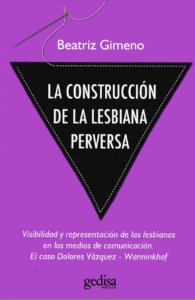 “La construccion de la lesbiana perversa: visibilidad y representación de las lesbianas en los medios de comunicación. El caso de Dolores Vázquez-Wanninkhof” (“The Construction of the Perverse Lesbian: Visibility and Representation of Lesbians in the Media – The Case of Dolores Vázquez-Wanninkhof”) · Beatriz Gimeno · Gedisa, 2008
An exhaustive political and media analysis of how lesbophobia was used to convict an innocent woman, and why it worked without a single protest from the press.
“Dolores Vázquez was accused, prosecuted and convicted for being a lesbian, and none of what happened could have happened in the same way had she been heterosexual.”
Beatriz Gimeno, La construcción de la lesbiana perversa (Gimeno, 2008:17)
From the first day of coverage, Dolores was not treated as a suspect to be investigated. She was a type to be confirmed. The newspapers built her body before they built a case against her. On day one, El País described her as having a “normal build”. The very next day, ABC already had her as a “woman of great corpulence”. Why? Because the forensic evidence showed the killer had carried the body alone. Therefore, the killer had to be strong. Therefore, Dolores had to be strong. The description changed to fit the theory.
She was reported to practise martial arts. And jogging. And weightlifting –the details shifted from article to article. None of it was verified. All of it served the same purpose: to draw the image of a masculinised, physical, dangerous woman. A lesbian body coded as threat.
Gimeno is precise about this mechanism: “It was not just about characterising her physically as a lesbian. It was necessary to give her the psychological traits of perverted lesbians: cold, calculating, possessive, violent”. The press repeated these adjectives until they became facts in the public mind.
And yet, significantly, almost no newspaper ever printed the word lesbian or lesbianism when describing Dolores. El País and ABC never used it once. Instead, readers encountered “former sentimental companion”, “intimate friend”, or simply nothing: a knowing silence that let the prejudice do its work without ever having to name itself. As Gimeno writes, this is not neutrality. It is lesbophobia operating through invisibility: the threat is everywhere, unnamed and therefore impossible to challenge.
The presumption of guilt: a lesbian on trial for existing
When the trial finally began in September 2001 at the Provincial Court of Málaga, it became clear that what was on trial was not whether Dolores had committed a murder. What was on trial was whether she was the kind of woman who could.
The prosecution’s strategy was built almost entirely on discrediting her as a lesbian. The fiscal interrogated her about her “masculine role” in the relationship with Alicia Hornos (the victim’s mother). He framed their decade-long partnership as one of domination and exploitation. The fact that Dolores had helped raise Rocío and her siblings –that the children called her “godmother”, that her own family refused to believe she could have harmed a child she had dressed and fed and walked to school– was irrelevant. What mattered was the story of the predatory lesbian who had seduced an otherwise-straight woman and corrupted her family.
Dolores did not cry during the trial. She did not break down. She maintained her composure, her dignity, and her assertion of innocence without wavering. The media called this “coldness”. They called it “masculine emotional control”. It became, in the language of the courtroom and the press, further evidence of guilt. A woman who does not weep must be hiding something.
“Dolores Vázquez was never forgiven for her courage, or for maintaining her personal dignity throughout. The supposed killer had no feminine character, and not a single newspaper failed to note it.”
eldiario.es – June 21, 2021 – ‘Caso Wanninkhof-Carabantes’: cómo la lesbofobia convirtió en asesina a una mujer inocente
Compare this with Tony Alexander King –the British man who actually killed Rocío Wanninkhof, and who would later confess. During his own proceedings, King shouted at judges, threatened people, raged. No outlet described this as abnormal. No commentator called him cold. Men who lose control are troubled. Lesbians who keep it are calculating.
Without a single piece of direct evidence, a nine-person jury –with two dissenting votes for acquittal– convicted Dolores Vázquez to fifteen years in prison and an indemnification of 18 million pesetas. The conviction was later annulled by the Andalusian High Court, which ruled that the verdict lacked sufficient legal reasoning, that the jury had never properly explained the basis for its conclusion. But Dolores had already spent 519 days behind bars.
A document of hatred: the Sagaseta column
In September 2003 — after Tony King had confessed, after Dolores’s innocence was no longer in doubt — a journalist named Salvador Sagaseta published the following in La Provincia, a major regional newspaper in the Canary Islands. We quote it here because it must be read.
“If I had been on the popular jury, I would almost certainly also have convicted Dolores Vázquez. Even now that her innocence has been proven, I still find the character so repellent — short, fat-arsed, lesbian, with an obvious face full of ill-will — that I would have sent her to the lions without blinking. […] I still find the lesbo in question so suspicious that, even if not for this crime, I believe her capable of another murder.”
Salvador Sagaseta · La Provincia / Diario de Las Palmas · 24 September 2003. SOURCE: Carla Antonelli’s website
This was published in a newspaper. After her innocence was proven. The author acknowledged that there was no evidence, and said he would have convicted her anyway. Because she was a lesbian. Because of how she looked. Because of what she was.
This text is extraordinary because it says out loud what the courts, the press, and the police had been carrying out for three years without ever putting it in writing. Sagaseta simply removed the euphemisms. Beneath every “cold temperament” and “masculine bearing” and “suspicious attitude”, this was always the sentence being passed: guilty at first sight, because she is one of them.
What the silence cost – and what is owed
After her conviction was annulled, Dolores left Spain. She rebuilt her life elsewhere, away from the country that had destroyed her reputation, taken seventeen months of her freedom, and never apologised.
No senior official said sorry. No newspaper that ran the headlines ran a retraction. The experts who had testified against her –including a psychologist who described her as “authoritarian, conceited, violent and aggressive” with “uncontrolled impulses”– were never called to account. When the media finally acknowledged that the wrong person had been convicted, their editorials managed, somehow, not to mention lesbophobia once. Not once. In any of the three major papers Gimeno studied.
Beyond the Spanish legal history, this is a case study in how lesbophobia functions: not as spectacular hatred alone, but as a quiet, systemic assumption that a lesbian relationship is by definition dysfunctional, that a lesbian woman is by definition a credible suspect, that a lesbian body is by definition something to fear. It is the mechanism Gimeno names with precision: first, make her invisible as a real person. Then, when invisibility fails, make her monstrous.
Today, in Madrid
Twenty-six years after her arrest, Dolores Vázquez is receiving an institutional act of recognition from the Spanish Ministry of Equality. She asked for an apology from the government. She asked for one from the Ministry of Interior. She asked for this in her own words, in the documentary that bears her name. We do not know exactly what today will give her. But she will be in the room. And so will we.
EL*C at the reparation act: The EuroCentralAsian Lesbian* Community is represented today in Madrid by Eva Pérez Nanclares, EL*C Co-Treasurer and moderator of today’s panel on lesbophobia, and Kika Fumero, EL*C Media and Communication Manager. We are there because Dolores’s case is ours. It belongs to every country where being a lesbian is still treated as a character flaw, a motive, a warning sign. Which is most of them.
The real killer had left evidence from the beginning. A cigarette butt next to the body. DNA. A pattern of violence across two countries. None of it was followed because there was a lesbian nearby, and that was considered sufficient for society.
Dolores (Loli) Vázquez spent 519 days in prison for a crime she did not commit. She spent 26 years waiting for the word sorry.
We say her name. We name what was done to her. And we insist: this cannot happen again –not to her, not to any of us– until every institution involved understands, precisely, what it did.