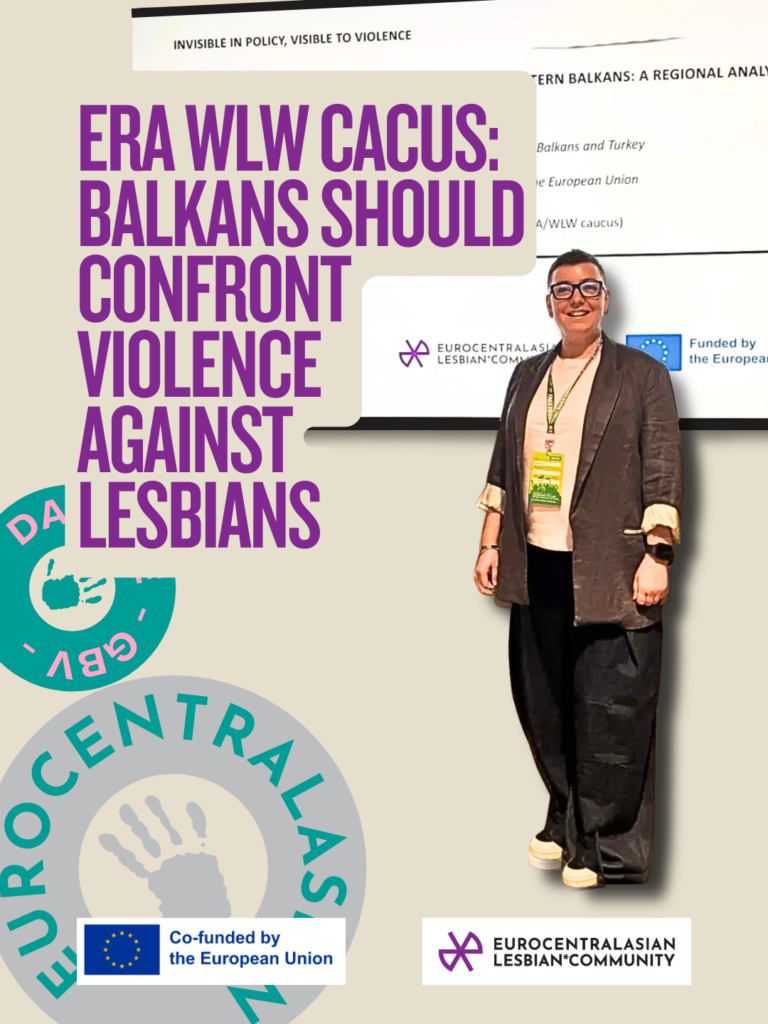

Imagine policies on violence against women that include lesbians. Not as a footnote. Not as an afterthought. Not as a polite acronym added at the end of a strategy document. But as subjects of protection.
Across parts of the western Balkans, national gender-equality frameworks speak in universal terms, yet too often fail to recognise how violence manifests when the survivor is a lesbian, a bisexual woman, a queer woman or a non-binary lesbian person. Family rejection, denial of services, forced outing, institutional indifference – these experiences slip through the cracks of systems designed around heterosexual assumptions.
With financial support from the EL*C’s Grant-Making Programme Against Gender-Based Violence, the Women Loving Women (WLW) Caucus of ERA LGBTI set out to change that. Their project did something deceptively simple and politically radical: it made lesbian lives visible in policy.
Evidence as a political intervention
Focusing on Kosovo, Serbia, Bosnia and Herzegovina, and Albania, the WLW Caucus undertook a deep analysis of how gender-based violence frameworks – including the implementation of the Istanbul Convention – address, or fail to address, lesbian realities.
Through literature reviews, national focus groups and interviews, they documented what activists have long known: data on LBQ survivors is scarce; frontline services are rarely trained to respond appropriately; reporting mechanisms do not account for the risks of outing or discrimination.
The outcome was a comparative regional report, followed by four country-specific policy papers offering concrete recommendations – from LBQ-inclusive reporting protocols to targeted ministry trainings. This was not research for the sake of visibility alone. It was advocacy ammunition: tools for activists pushing for shelters that welcome lesbians, police procedures that do not retraumatise them, and laws that acknowledge their existence.
An accompanying online campaign amplified the findings across social media, reaching thousands and placing lesbian-specific GBV squarely into public debate. WLW representatives also brought the conversation to EL*C’s 4th EuroCentralAsian Conference in Rome, connecting Balkan realities to broader European struggles.
From documentation to accountability
 If the first phase was about evidence, the next is about leverage. The ERA WLW Caucus has secured €30,000 in the Daphne programme’s second cycle to translate research into practice.
Five national roundtables will bring ministries, police, social services and lesbian-led organisations into direct conversation. The aim is not symbolic dialogue, but procedural change: embedding LBQ-inclusive standards into GBV responses and ensuring institutions cannot claim ignorance.
The lesson is clear. When lesbian activists are resourced, they do not merely participate in policy debates – they reshape them. They turn invisibility into documentation, documentation into demands, and demands into pressure for reform.
For the Balkans, where democratic backsliding and anti-gender rhetoric remain potent forces, this work is not peripheral. It is a measure of whether commitments to equality withstand scrutiny.
Violence against lesbians will not disappear because it is politely acknowledged. It shifts when systems are forced to see it. The WLW Caucus has ensured that, at least in four countries, looking away is no longer an option.
NOTE: You can learn more about the results of the first cycle of the EL*C’s Grant-Making Programme by reading this article.