
Imagine a Europe where lesbian and bisexual women, queer and non-binary people no longer have to hide the scars of gender-based violence. That ambition sits at the heart of EL*C’s Grant-Making Programme Against Gender-Based Violence, which backs grassroots organisations working to close persistent protection gaps across the continent. Among the first cycle’s projects, one initiative in Serbia has taken on a form of violence still too rarely acknowledged: abuse within lesbian relationships.
Labris –Lesbian Human Rights Organisation, based in Belgrade and one of the Western Balkans’ longest-standing lesbian groups– used the programme to expand years of work documenting and confronting partner violence among LBTIQ women. Their project, Prevention of Violence in Romantic Relationships of LBTIQ Women and Non-Binary Persons and Ensuring Adequate Support and Protection, set out to challenge both silence within communities and institutional blind spots that leave many survivors without support.
Naming what remains unseen
Research conducted by Labris shows that LBTIQ women in Serbia encounter violence not only within families, public spaces and institutions, but also in intimate relationships, an area where legislation and services often fail to recognise same-sex partner abuse. The project therefore combined community empowerment with policy advocacy, aiming to help survivors identify violence and seek help while pushing authorities to strengthen prevention and protection mechanisms.
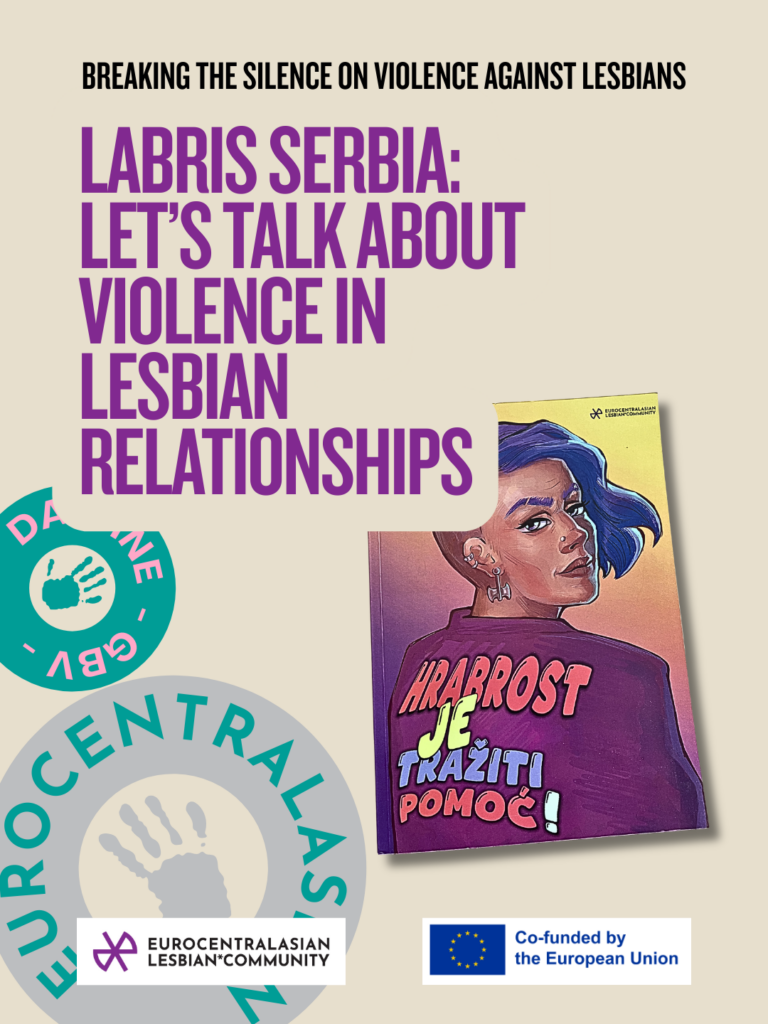
With EL*C’s financial support, Labris organised training sessions for lesbians on recognising abuse, self-defence and accessing support services. Additional workshops equipped activists and staff from feminist, LBTIQ and human rights organisations across Serbia’s major cities to respond more effectively to survivors. To reach beyond workshops, the team produced an educational graphic novel on healthy relationships and self-care, distributed in print and online.
Support services were expanded alongside prevention work. Survivors could access psychological counselling and legal advice through in-person meetings, video sessions and online chat. Legal consultations offered guidance on rights and procedures in a legal system that does not consistently recognise same-sex partnerships. A targeted social media campaign promoted these services while raising awareness of emotional, psychological and economic abuse within queer relationships.
Advocacy formed a parallel strand. Labris convened meetings and round tables with ministries, social-welfare centres and police representatives in Belgrade, Niš and Novi Sad, using research evidence to argue for clearer recognition of same-sex couples within domestic-violence protocols, in line with interpretations by Serbia’s supreme court.
By the project’s end, dozens of activists and professionals had strengthened their capacity to support lesbian survivors, while new users were already accessing psychological and legal assistance. Workshops and educational materials helped community members recognise abuse even when it does not fit heteronormative assumptions about violence. Institutions in several cities began engaging more seriously with the issue, and Labris consolidated its role as a key interlocutor in national policy debates.
From October 2025, the organisation is now implementing a second EL*C regranting cycle, scaling up research, advocacy and nationwide campaigning alongside continued counselling and legal support. The aim is simple but urgent: to build lasting systems of protection so that no lesbian or queer survivor in Serbia has to face violence alone.
NOTE: You can learn more about the results of the first cycle of the EL*C’s Grant-Making Programme by reading this article.