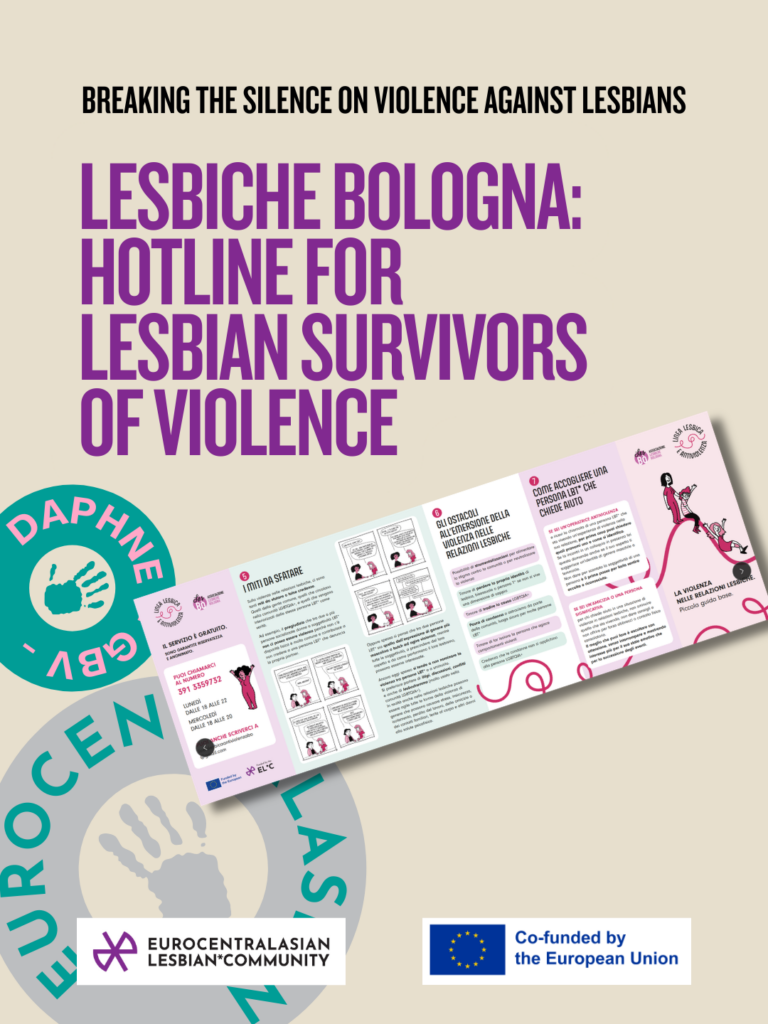

 Across Europe, violence in lesbian relationships is still too often minimised as a private conflict rather than recognised as gender-based violence. In Bologna, a small but determined collective is challenging that silence. With financial support from EL*C’s Grant-Making Programme Against Gender-Based Violence, Lesbiche Bologna has strengthened a specialised hotline offering support to lesbians, bisexual women and non-binary people experiencing abuse from intimate partners.
The project – Aware and Free. Pathways out of violence in LBTIQ relationships and cultural change in the work of the Lesbian and Anti-Violence Line – focused on expanding the Lesbian and Anti-Violence Line (LLA), one of the few services in Europe dedicated specifically to survivors of lesbophobic and intimate partner violence within lesbian relationships.
From activist knowledge to structured support
Our funding allowed the organisation to stabilise what had long relied on volunteer labour. Seven hotline operators, coordinators and administrative staff were partially remunerated, ensuring regular opening hours and the possibility of sustained support rather than one-off emergency conversations. Regular supervision by a psychotherapist helped prevent burnout among operators working with complex trauma cases.
The project also invested heavily in training and knowledge-sharing. Sessions led by external experts addressed migration and asylum, disability, neurodivergence and mental health, strengthening the team’s intersectional approach. Residential retreats created space for collective political analysis and shared methodologies. Years of frontline experience were distilled into a practical toolkit designed for both activists and professionals working on gender-based violence.
Visibility was another priority. A communications campaign developed with a feminist agency combined original illustrations, social media content and a promotional video, alongside 10,000 hotline stickers distributed at festivals, Pride events and community gatherings. Outreach at the Some Prefer Cake Lesbian Film Festival and presentations at international conferences helped connect the hotline to wider feminist and LGBTIQ networks.
The results were immediate. More survivors contacted the line, and operators reported greater confidence in supporting complex situations involving migration status, disability or mental health challenges. Internally, the hotline now operates with a larger, more stable team and a shared methodology capable of influencing broader anti-violence systems beyond activist circles.
Building on this momentum, Lesbiche Bologna has secured further funding in the programme’s second cycle to expand nationwide outreach, develop partnerships and train external services to recognise violence affecting LBT* survivors – an effort aimed at ensuring that gender-based violence systems in Italy finally recognise those too often overlooked.
NOTE: You can learn more about the results of the first cycle of the EL*C’s Grant-Making Programme by reading this article.