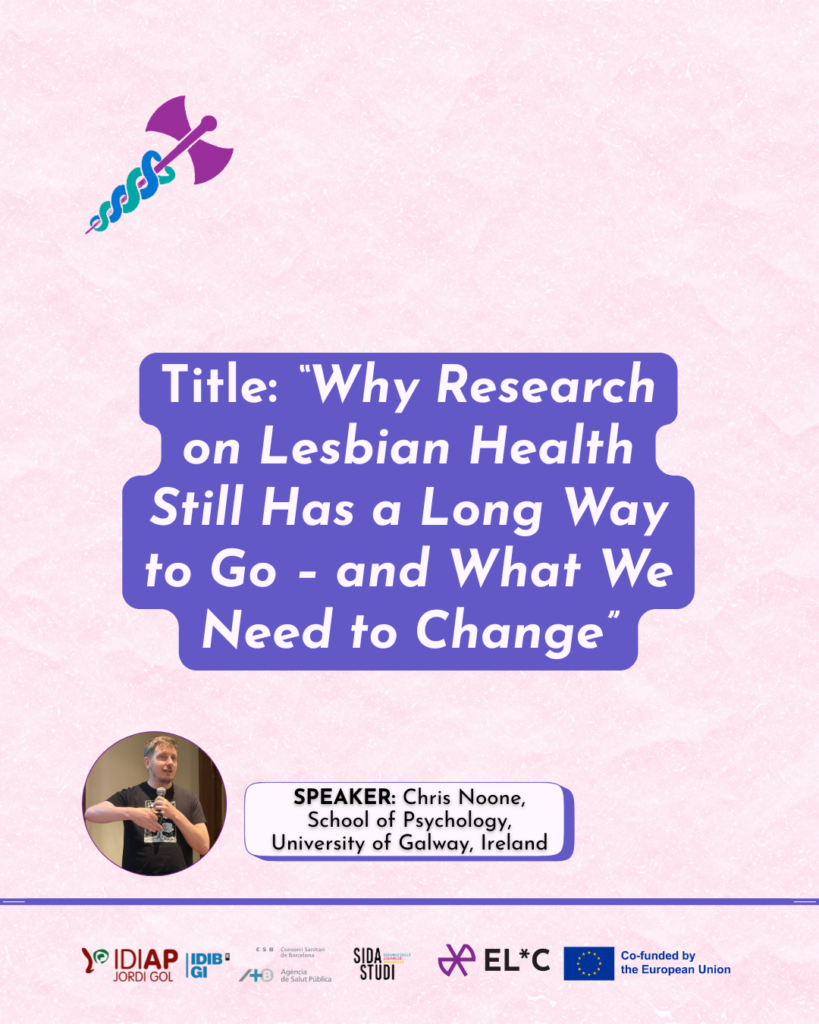

Dr Chris Noone, from the School of Psychology at the University of Galway (Ireland), presented a compelling overview of the state of LGBTQ+ health research at the L-Health Project Final Conference. As he highlighted, we know too little, we research the wrong things, and we urgently need new frameworks.
Barcelona, Spain · 11 June 2026 · EuroCentralAsian Lesbian* Community (EL*C) · L-Health Project Final Conference
When Dr Chris Noone took the floor at the L-Health Final Conference in Barcelona on 11 June 2026, he opened with a deceptively simple question: how do we investigate lesbian realities across Europe? The answer, as his presentation made clear, is that we are barely doing it – and when we do, we are often doing it wrong.
Noone’s talk offered a rigorous reflection on the gaps, biases and limitations of existing LGBTQ+ health research, and pointed towards the kind of frameworks we need if we want science to actually serve lesbian and bisexual women.
The research that exists and the research that doesn’t
The dominant framework for understanding LGBTQ+ health today is Minority Stress Theory, developed originally by Virginia R. Brooks in 1981 in her foundational book Minority Stress and Lesbian Women (Lexington Books), and later expanded by Ilan H. Meyer in his 2003 article Prejudice, Social Stress, and Mental Health in Lesbian, Gay, and Bisexual Populations: Conceptual Issues and Research Evidence (’Psychological Bulletin’, vol. 129, no. 5).
Meyer’s model has accumulated over 22,374 citations since 2003, compared to 2,404 for Brooks’ original work since 1981 — a gap that is itself revealing. It was not until 2020 that a formal call was made to restore Brooks’ place in the history of the field, when Rich, Salway, Scheim and Poteat published “Sexual Minority Stress Theory: Remembering and Honoring the Work of Virginia Brooks” in LGBT Health — a reminder that the erasure of women from scientific history is not unique to the healthcare system.
The problem? As Noone highlighted, most research within this tradition focuses on gay men. Sexual minority women remain, as a 2020 scoping review published in the Journal of Advanced Nursing put it, “grossly underrepresented in the reviewed literature, despite evidence from international research showing that lesbians and bisexual women often experience unique health risks, including lower rates of STI screening, higher rates of smoking and alcohol use, and increased risk of certain cancers” (Gilmore et al., 2020).
“Sexual minority women are grossly underrepresented in the reviewed literature, despite evidence from international research showing that lesbians and bisexual women often experience unique health risks.”
Two models, one conclusion: structure matters
Noone walked the audience through the evolution of minority stress models, from Brooks’ original model (1981) – which traced how culturally ascribed inferiority leads to prejudiced attitudes and discriminatory behaviours, resulting in a state of stress — to Meyer’s expanded model (2003), which introduced the concepts of distal stressors (prejudice events, discrimination, violence) and proximal stressors (expectations of rejection, concealment, internalised homophobia). More recent models, such as the temporal intersectional minority stress model (Rivas-Koehl, Rivas-Koehl & McNeil Smith, 2023) and the socioecological minority stress model (van der Star, 2024), have begun to incorporate historical time, generational context, and structural hegemonies into the framework.
What all these models share is a recognition that the health inequalities experienced by lesbian and bisexual women are structural outcomes. They are produced by systems, not by identities.
Lesbophobia as a form of misogyny
One of the most politically sharp moments of Noone’s presentation came when he addressed lesbophobia directly as a specific form of misogyny. Drawing on Adrienne Rich’s concept of compulsory heterosexuality (Rich, 1980) and recent work by M. Concepción Unanue Cuesta (’Beyond Legal Equality: Lesbophobia, Endolesbophobia and Lesbian Everyday Life in Contemporary Spain’, Journal of Homosexuality, 2026), he argued that:
“Lesbophobia, in this view, is not simply a form of sexual prejudice, but a mechanism for disciplining women who deviate from the expectations of feminine availability, domesticity and relationality.”
Lesbians, in this framework, pose a particular challenge to the heteropatriarchal order: they refuse the alignment between womanhood and male-centred heterosexuality. And the system responds – including within healthcare – by making them invisible, pathologising them, or simply pretending they do not exist.
What good research on LesBian health actually looks like
For Noone, the L-Health project is a model worth building on precisely because it does several things that most LGBTQ+ health research does not. It:
- Makes lesbian health visible for researchers and healthcare workers, instead of subsuming it under broader LGBTQ+ categories dominated by gay male experience.
- Works with lesbian, bisexual and queer women instead of merely extracting information from them – a key distinction between participatory research and extractive research.
- Attends to intersectionality in a way that centres structural oppression rather than identity labels, recognising that racialisation, disability, age and migration histories shape health outcomes differently for different women.
- Supports primary healthcare workers to develop structural competence and humility, recognising that inclusive healthcare benefits everyone.
- Critically considers the role of community resources, social support, and what he called “Queer Joy” as protective health factors — moving beyond deficit narratives.
The question we must keep asking
Noone closed with a framework for what LesBian* health research needs to do going forward. Models specific to lesbian, bisexual and queer women should, in his view:
- Recognise lesbophobia as a form of misogyny that operates both within and beyond LGBTQ+ communities
- Account for cross-cultural values and patriarchal structures rather than assuming a universal experience
- Understand how diversity within lesbian cultures relates to health outcomes
- Move beyond knowledge that only focuses on difference and comparison with heterosexual populations
- Reject narratives of deficit, vulnerability and risk as the primary lens
- Acknowledge resistance to patriarchy and heteronormativity as a source of health and strength
He concluded with a citation from Hagai & Starr (2023) that gathers much of what L-Health has been trying to demonstrate:
“These oppressions of sexism, misogyny, and lesbophobia are interlocking together with cultural differences and structural barriers creating a unique lesbian experience across geographical locations.” Hagai, E.B. & Starr, C.R. (2023), cited in Noone, C. (2026). Researching LesBians* Realities Across Europe. L-Health Final Conference, Barcelona.
The L-Health project –coordinated by the IDIAPJGol and co-funded by the European Commission through the CERV programme, with partners IDIBGI, the Agència de Salut Pública de Barcelona, Sida Studi and the EuroCentralAsian Lesbian* Community NGO – EL*C – is one small but significant step in that direction. Science that centres our lives. Research that works with us, not on us.
This article is based on the presentation “Researching LesBians* Realities Across Europe” delivered by Dr Chris Noone (School of Psychology, University of Galway, Ireland) at the L-Health Final Conference, Barcelona, 11 June 2026.
REFERENCES:
- Gilmore, J. P., T. L. Hughes, S. Kearns, et al. 2026. “Scoping Review of Sexual and Gender Minority Health Research in Ireland.” Journal of Advanced Nursing82, no. 5: 4625–4659. https://doi.org/10.1111/jan.70201
- Meyer, I. H. (2003). Prejudice, social stress, and mental health in lesbian, gay, and bisexual populations: Conceptual issues and research evidence. Psychological Bulletin, 129(5), 674–697. https://doi.org/10.1037/0033-2909.129.5.674
- Rich, A. (1980). Compulsory Heterosexuality and Lesbian Existence. Signs, 5(4), 631–660. https://www.theaproject.org/sites/default/files/2023-11/12._adrienne_rich_1980.pdf
- Rich, A. J., Salway, T., Scheim, A., & Poteat, T. (2020). Sexual minority stress theory: Remembering and honoring the work of Virginia Brooks. LGBT Health, 7(3), 124–127. https://doi.org/10.1089/lgbt.2019.0223
- Rivas-Koehl, M., Rivas-Koehl, D., & McNeil Smith, S. (2023). The temporal intersectional minority stress model: Reimagining minority stress theory. Journal of Family Theory & Review, 15(4), 706–726. https://doi.org/10.1111/jftr.12529
- Unanue Cuesta M. C. (2026). Beyond Legal Equality: Lesbophobia, Endolesbophobia and Lesbian Everyday Life in Contemporary Spain. Journal of homosexuality, 1–22. Advance online publication. https://doi.org/10.1080/00918369.2026.2675357
- van der Star, A. (2024). The socioecology of sexual minority stigma: Advancing theory on stigma-based mechanisms underlying sexual orientation-based disparities in health. Social Science & Medicine, 363, 117484. https://doi.org/10.1016/j.socscimed.2024.117484