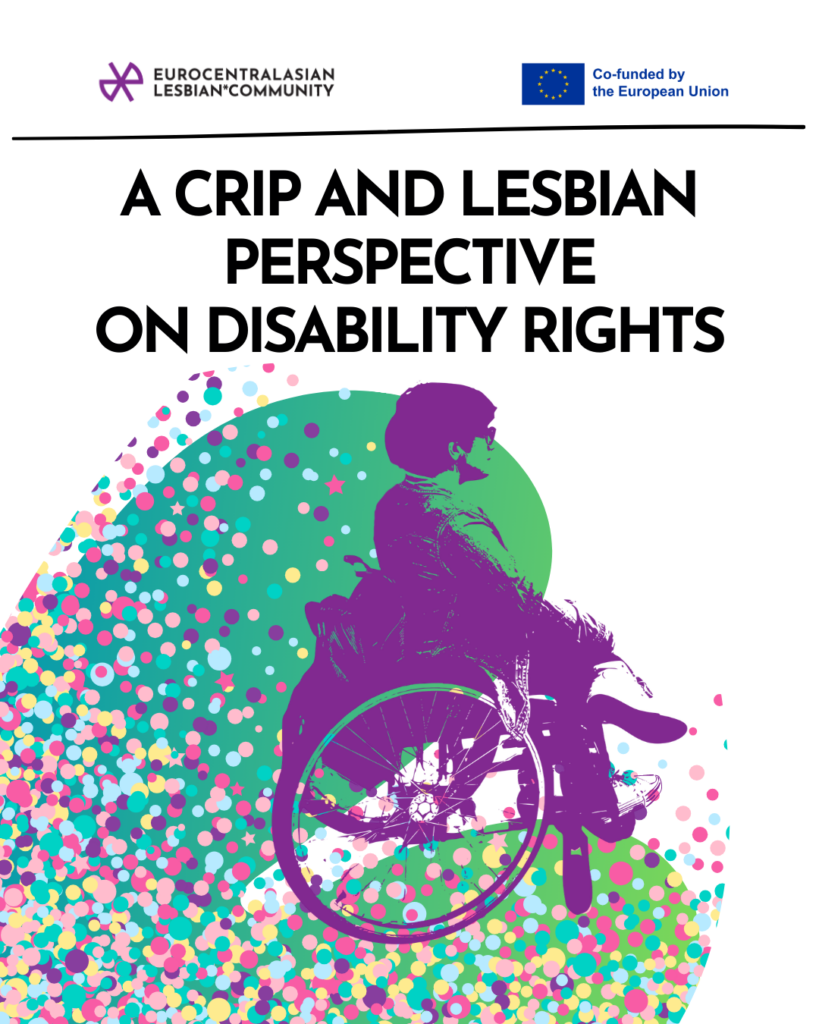

With this new report, EL*C brings attention to a reality that remains largely invisible in both disability policy and gender equality policy: the lived experiences of LBQ women and nonbinary persons with disabilities in Europe. While EU frameworks increasingly refer to intersectionality, these realities are still too often left out of law, policy, data collection, and service provision.
At the centre of the research is the UN Convention on the Rights of Persons with Disabilities, the main international human rights framework on disability ratified by the EU. The report examines how the CRPD can be interpreted and used more ambitiously to recognise and protect LBQ women and nonbinary persons with disabilities. Drawing on feminist disability studies, crip theory, and Disability Justice, the publication shows that the Convention already contains important interpretative potential, but that this potential still remains underused.
The report combines legal and policy analysis with community-based knowledge. It is based on consultations with the European Disability Forum and Women Enabled International, a workshop with more than 40 activists from lesbian organisations across the EU, and a group interview with queer, crip, and disabled activists from several European countries.
Its findings show both the scale of the gaps and the urgency of action:
- data on the intersection of disability, gender, and sexuality remains extremely limited, contributing to the invisibility of LBQ women and nonbinary persons with disabilities in policymaking
- LBQ women and nonbinary persons with disabilities continue to face compounded discrimination in areas such as violence, health, family life, and access to services
- the report argues that a more consistent and intersectional reading of the CRPD is necessary if disability rights frameworks are to respond meaningfully to these realities
In view of the forthcoming revision of the EU Disability Strategy, this publication puts forward concrete recommendations for EU institutions and Member States, including better intersectional data, stronger protection against violence, more inclusive healthcare, and meaningful participation of LBQ women and nonbinary persons with disabilities in decision making.